“You can doubt that your body exists. You can’t doubt that your mind does, because the doubting itself is the mind.”
That line stopped me on my first lesson of Yale’s Introduction to Psychology course. I’d never actually stopped to question what my own mind was made of. So when the first module, “The Brain,” opened with that idea, I didn’t expect to still be turning it over days later.
Dualism
The idea is called dualism, the notion that we’re more than matter, that under the body there’s something else, something non-physical. Most religions are built on some version of it. And once I saw the shape of it, I started noticing it everywhere: beliefs about the afterlife, reincarnation, personal identity, even God. None of them make sense unless you already accept that the mind is separate from the brain. So dualism isn’t something people argue for. It’s the quiet assumption sitting underneath a lot of what they already believe.
But if the mind isn’t just the brain, what is the brain actually made of? That’s where the module went next.
Neurons
There are about 100 billion neurons in there, and the part that stuck with me wasn’t the number. It was that neurons don’t actually touch. There’s a tiny gap between them. A neuron fires, releases chemicals across that gap, and those chemicals turn the next neuron up or down, like a volume dial. That’s literally how drugs work on the brain: alcohol turns the dial down, amphetamines turn it up. And a neuron doesn’t do this halfway, it either fires completely or not at all.
So I kept thinking about how mechanical that is. Chemicals, gaps, dials. Not exactly what I picture when I think about a “thought.”
Parts of the brain
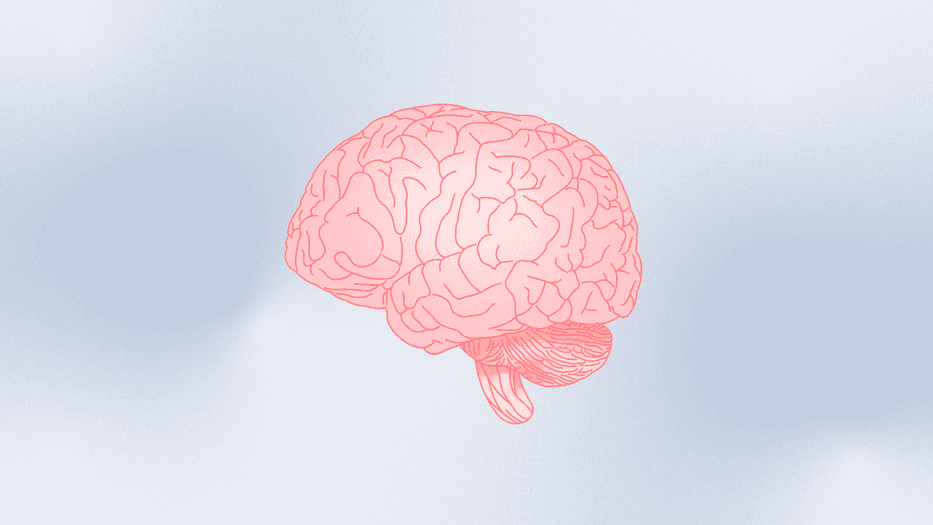
The brain has two layers: a subcortical layer running the basics (heart rate, breathing, movement, hunger, sleep) and the cerebral cortex on top, doing the part that supposedly “makes us human.” But what actually got me were the disorders that come from damage to that cortex. Someone with apraxia can move their limbs but can’t organize the movement into a purpose. Someone with agnosia can see every detail of a picture and still not know what it is. Someone with prosopagnosia can see a face, even their own family’s, and not recognize it. Someone with sensory neglect will ignore half the world so completely that, asked to draw a clock, they cram all twelve numbers onto one side.
And each one felt like a glitch in something I’d always assumed was solid. If a piece of tissue gets damaged and someone loses their sense of right and wrong, or their ability to hold back an impulse, was that ever really “who they are,” or just what the tissue was doing that day? I don’t have a clean answer, but the question itself changed how I read the word “character.”
Our two brains
Then the module got into hemispheres. Most right-handed people process language on the left side; left-handed people are more scattered. The right brain runs the left side of the body and vice versa. And the “creative people are right-brained, logical people are left-brained” thing you’ve probably heard, the course was pretty blunt about it: mostly nonsense. Almost every function lives in both hemispheres. One side just tends to lead.
What actually got me was the corpus callosum, the bundle of fibers connecting the two hemispheres that lets them talk to each other constantly. That’s why we experience one continuous world instead of two separate streams. Surgeons used to sever it to treat severe epilepsy, and it worked. But the patients effectively became two people in one body. The left hemisphere could speak. The right couldn’t, but it had its own awareness, its own reactions.
So I still don’t have an answer to the question that raised: if your brain were split in half, which half would be you?
A bit of humility
Modern science’s answer to all of this is blunt: dualism is wrong. The mind is the brain, one thing, not two. Brain as hardware, thoughts as software. When the brain dies, you end. It’s a clean explanation, and it explains a lot.
But then there’s what David Chalmers calls the “hard problem of consciousness.” Even if the brain produces experience, nobody can explain why physical processes feel like anything at all. Why does pain hurt? Why does red look red? Thomas Huxley called it a miracle. We know the brain creates consciousness. We just have no idea how.
What stays with me
I came into this module expecting a biology lesson. What I didn’t expect was that it would follow me out of it. Now when I run into something about the soul, or anything spiritual, I can’t just take it at face value anymore. There’s a question sitting in the back of my head now: is this dualism, or is this materialism? I didn’t have that lens before. I’m fairly sure I can’t put it down.